

Canadian Arrowhead (Sagittaria Rigida)
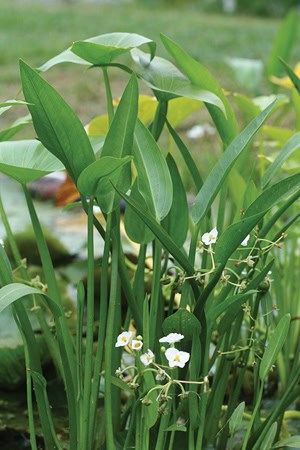
Early last year a new invasive species, Sagittaria Rigida, was discovered in Beaver Lake, thanks to our lake monitoring and response by the county Water and Land Resources Division. Unfortunately, Beaver Lake is the only body of water that currently is infested in King County, although two Snohomish lakes have also been identified with the noxious weed. There they have discovered that infestation occurs rapidly, is very dense, and removal has been slow and expensive.
To date, the weed has only been found in two general locations on the big lake: one on the western shore, near the centerline, and the other on the north end, near the big rock. Plants have only been found in clusters; no individual plants have been discovered (this is good news). In mid-July, after performing a broad survey, staff made a valiant first attempt to remove them. Plants were located, then hand-pulled by snorkelers and bagged for disposal. Though nearly 600 pounds of plant material was removed over several days, they were not able to clear all plant locations, due to water clarity and intermixing with other species.
Going forward additional efforts will be conducted, including regular surveys and hand-pulling where possible. They are also looking into effective herbicides to use for targeted purposes. Representatives of the county point out that it was our Beaver Lake Monitoring District that enabled early detection and is largely responsible for the funding for the extraction. Without the existence of the LMD, it is very likely that the result would have been much more dire.
We can help by keeping an eye out for this invader. While enjoying our lake, if we see evidence, please inform Chris Knutson of the county Lakes, Streams, Sound and Ground Unit.
According to Wikipedia, Sagittaria rigida, the sessilefruit arrowhead[2] or Canadian arrowhead,[3] is a fast-growing aquatic plant species. It has narrow oval leaves rather than the iconic arrowhead shaped leaves of species like the Sagittaria latifolia. it has sessile female flowers, from whence its name comes. Its flowers are very similar to other plants in the Sagittaria family, with three white petals.
It is native to Canada and some parts the United States, though not Washington state. Normally it grows in shallow waters along the edges of ponds and streams.